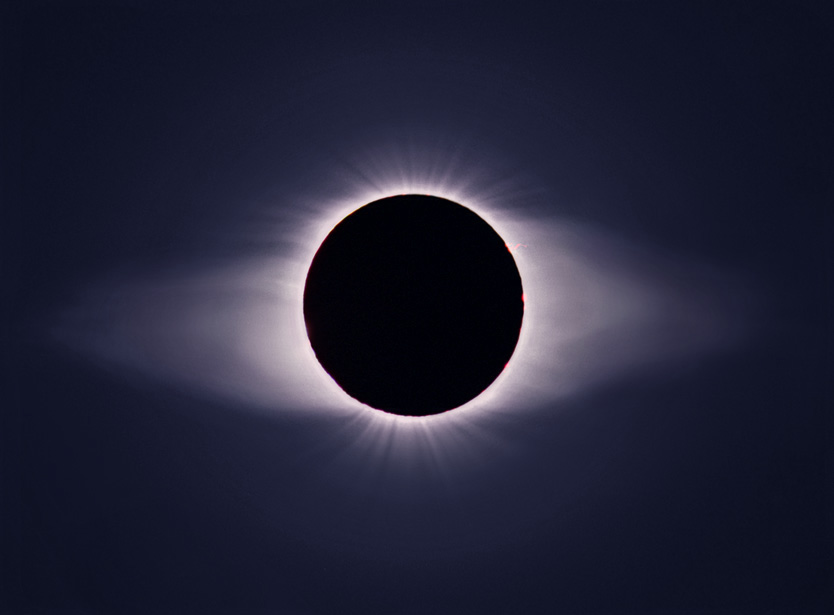
At its peak the moon will obscure about 66% of the sun, although the amounts will vary depending on location. The eclipse will also be visible over much of Europe, North Africa and central Asia. The Moon’s partial shadow (penumbra) will hit land at 6:40am GMT over Algeria, it will then travel across Europe passing Madrid, Paris, London, Copenhagen and then Dublin. The shadow will then track eastwards giving Russia, Kazakhstan, Mongolia and northwest China a sunset eclipse.
According to NASA Dublin will see the eclipse at 08:43 am GMT, in London it will be visible at 8:09 am GMT.
Enough of the sun should be blocked to lead to a darking of the morning sky, however Met Eireann and the British Met Office forecast that, as is often the case, there will be significant cloud cover during the eclipse.
In spite of any cloud cover the Royal Astronomical Society warns people not to look at the sun directly during the event.
Partial solar eclipses can be spectacular, but looking at the Sun directly (whether during an eclipse or at other times) can lead to permanent and severe eye damage and even blindness. The RAS therefore supports advice from the UK Chief Medical Officer, UK Department of Health and the Royal National Institute of Blind People that observers should NOT look directly at the Sun during this event.
Observers should also NEVER look directly at the Sun through a telescope, pair of binoculars or similar optical equipment.
The eclipse will not obscure the view of the Quadrantid meteor shower which will peak at 1:10am on the same day over Ireland and the UK.
By entering your location and choosing the amount of the sun or moon that will be obscured and the year range the NASA web application will show you when the astronomical event will happen where you live.
OpenAI published its proof attempts on February 14 for First Proof, a challenge put together…
We all know that a sedentary lifestyle is harmful to our health. But recent studies…
As organizations increasingly operate across hybrid and cloud-based email systems, migrating enterprise mailboxes has become…
Digital ID, programmable money like Central Bank Digital Currencies (CBDCs), and AI are paving the…
Earlier this year, Elon Musk was direct about what comes next for the global economy:…
Britive, provider of a unified privileged access management (PAM) platform, today announced its unified PAM…